Rokinon AF 85mm f/1.4 (for Nikon) Review
I have read some really glowing reviews of the Rokinon (Samyang) AF 85mm f/1.4 lens. They made it sound like it was better than my Nikkor 85mm f/1.4 AF-S G lens in every respect.
I respectfully disagree with most of what I have read. I only have a single copy of this lens, but I would regard it as pretty disappointing.

Rokinon 85mm f/1.4 on Nikon Z8 (with FTZ II adapter)

Rokinon AF 85mm f/1.4 with AF/MF switch
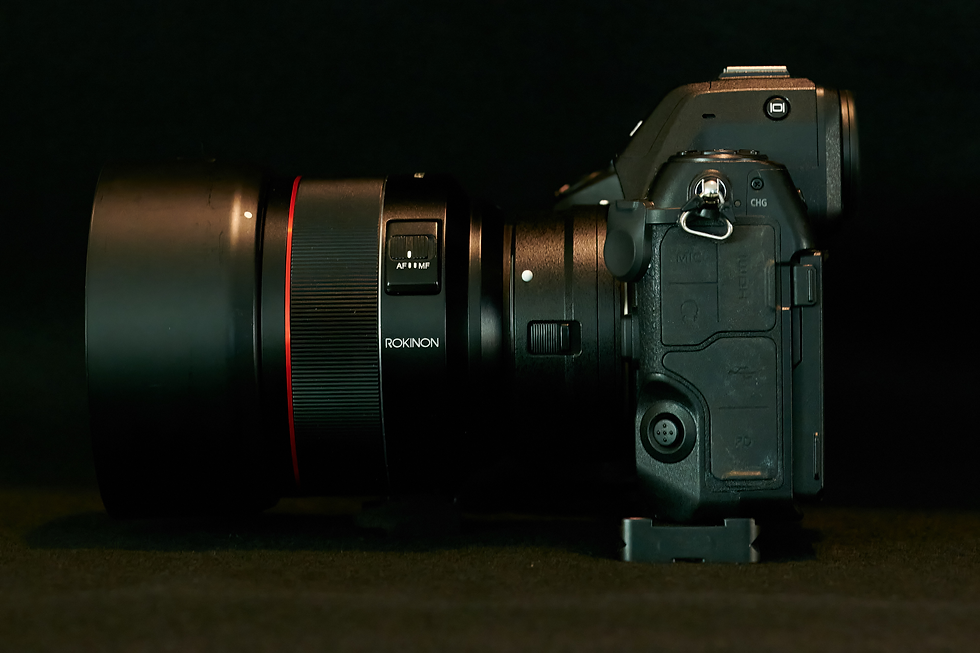
Rokinon AF 85mm f/1.4 with bayonet hood
You buy an f/1.4 lens for its bright aperture and narrow focus depth. In the testing that follows, you’ll see that at f/1.4 it has terrible resolution, noticeable lateral chromatic aberration, red/green longitudinal chromatic aberration (LoCA), and huge spherical aberration.
The lens looks nice, it feels solid, and the focus is smooth. It just doesn’t perform where it counts. By f/5.6, the lens is fine; unfortunately, this isn’t why somebody buys an f/1.4 lens.
Specifications
9 elements in 7 groups, with 1 aspherical element
77mm filter thread
0.9 meter minimum focus
480 grams
Dual Linear Sonic Motor focus
Metal construction
Weather sealed
9 rounded aperture blades, with minimum aperture f/16

Rokinon 85mm at f/1.4 on Nikon Z8
If you’re not very concerned about being sharp at f/1.4, then this lens could work for you. Backgrounds melt away just fine. Note that there is some color fringing around the out-of-focus edges of the neutral gray vase.

Eye at f/1.4 (left), f/2.0 and f/2.8 (right) at 200% magnification

Eye at f/4.0 (left) and f/5.6 (right) at 200% magnification

Eye with sharpening at f/1.4 (left) and f/5.6 (right)
Even with sharpening (I used Topaz Photo Studio), you can’t get sharp shots at f/1.4. If you like the wide-open effect, however, then this lens might work for you.
Resolution Measurements
This lens has some very unusual sharpness results. The location of maximum sharpness does some traveling around when the aperture is changed. Wide open, the lens looks like it has tilt to it, but smaller apertures make it go away.
I consider a lens to look sharp at an MTF50 of about 30 lp/mm. This lens has some sharp aspects starting at f/2.0, but the edges are mostly dismal.
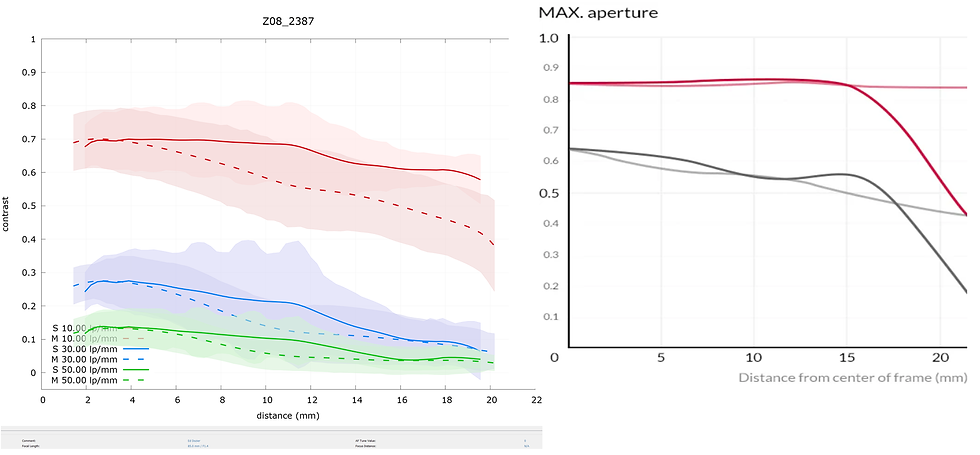
MTF contrast f/1.4 actual measurement versus Rokinon claims
The measured contrast results aren’t even close to the ‘theoretical’ predictions. I have included the 50 lp/mm measurements, besides the traditional 10 lp/mm and 30 lp/mm.
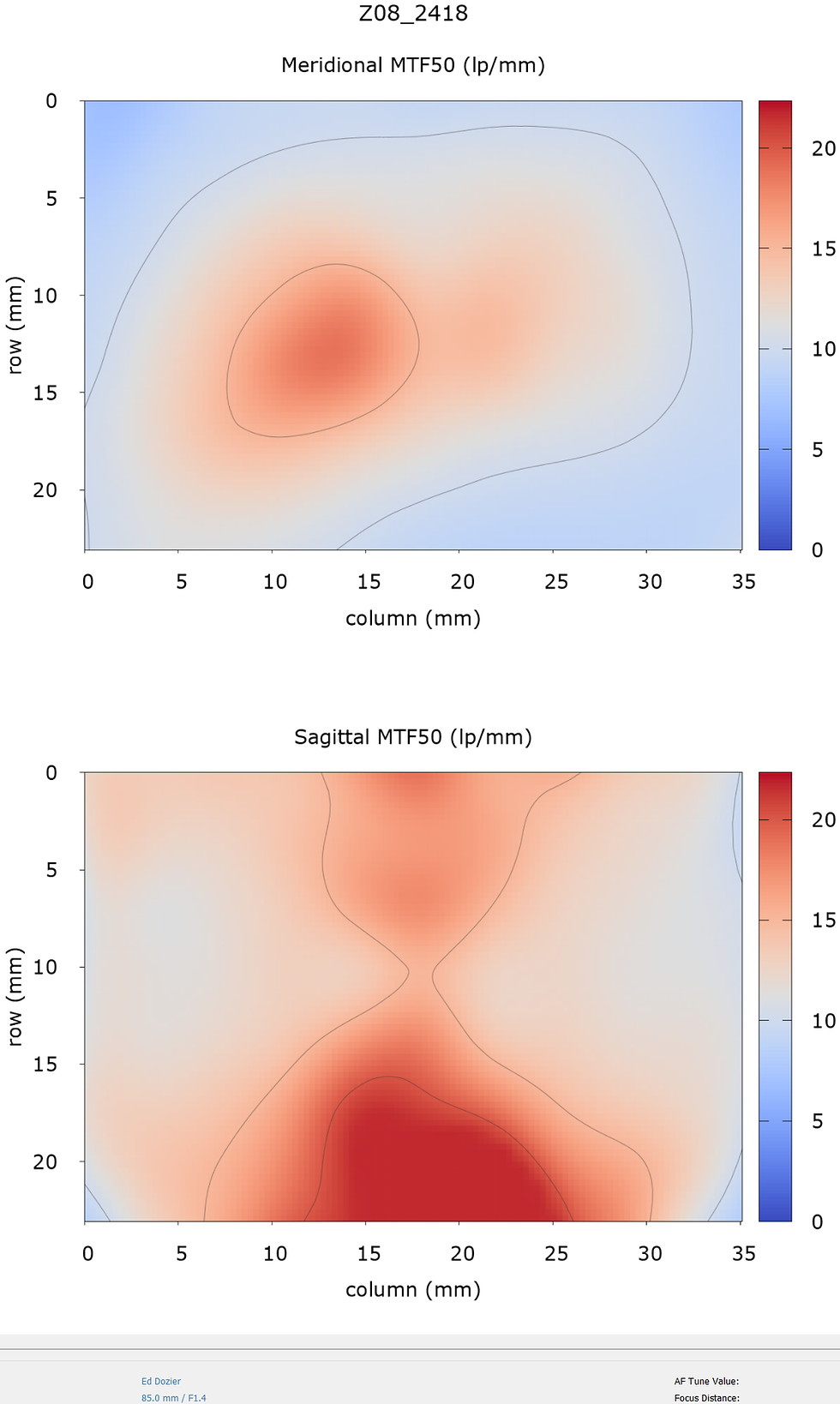
f/1.4 MTF50 Results. Maximum is 29.0 lp/mm
Sharpest results are at the bottom edge, in the sagittal direction. Very unusual. Not really sharp anywhere.

f/2.0 MTF50 Results. Maximum is 36.1 lp/mm
Sharpest results are still at the bottom edge, in the sagittal direction. Only a sliver of acceptable sharpness in the lens midsection.

f/2.8 MTF50 Results. Maximum is 54.9 lp/mm

f/4.0 MTF50 Results. Maximum is 55.3 lp/mm
Now, the sharpest location has shifted to the top of the lens. This is the lens sharpest aperture. Still dismal results on the edges.

f/5.6 MTF50 Results. Maximum is 54.3 lp/mm
The sharpest zone is finally moving toward the lens center. The meridional direction is finally starting to sharpen. Edges are starting to become acceptable.

f/8.0 MTF50 Results. Maximum is 52.4 lp/mm

f/11.0 MTF50 Results. Maximum is 46.7 lp/mm

f/16.0 MTF50 Results. Maximum is 37.9 lp/mm
Field curvature

85mm f/1.4 field curvature
It looks like there’s just slight field curvature.The red/green hue is indicative of the lens longitudinal chromatic aberration, with purple/red in the front and green behind the focused subject.
Londitudinal Chromatic Aberration (LoCA)

LoCA is noticeable: purple/red in front, green behind f/1.4
Longitudinal chromatic aberration is definitely there at f/1.4, but not terrible.
Lateral Chromatic Aberration (CA)

Lateral Chromatic Aberration (CA) will be noticed at f/1.4

9 lens elements in 7 groups, courtesy of Rokinon
Bokeh

Cat’s eye out-of-focus lights, not objectionable, f/1.4
Out-of-focus highlights are brighter around the edges, but not too severe. They seem slightly asymmetric, too.
Vignetting and Distortion

f/1.4 fairly heavy vignetting, but minimal distortion
Spherical Aberration
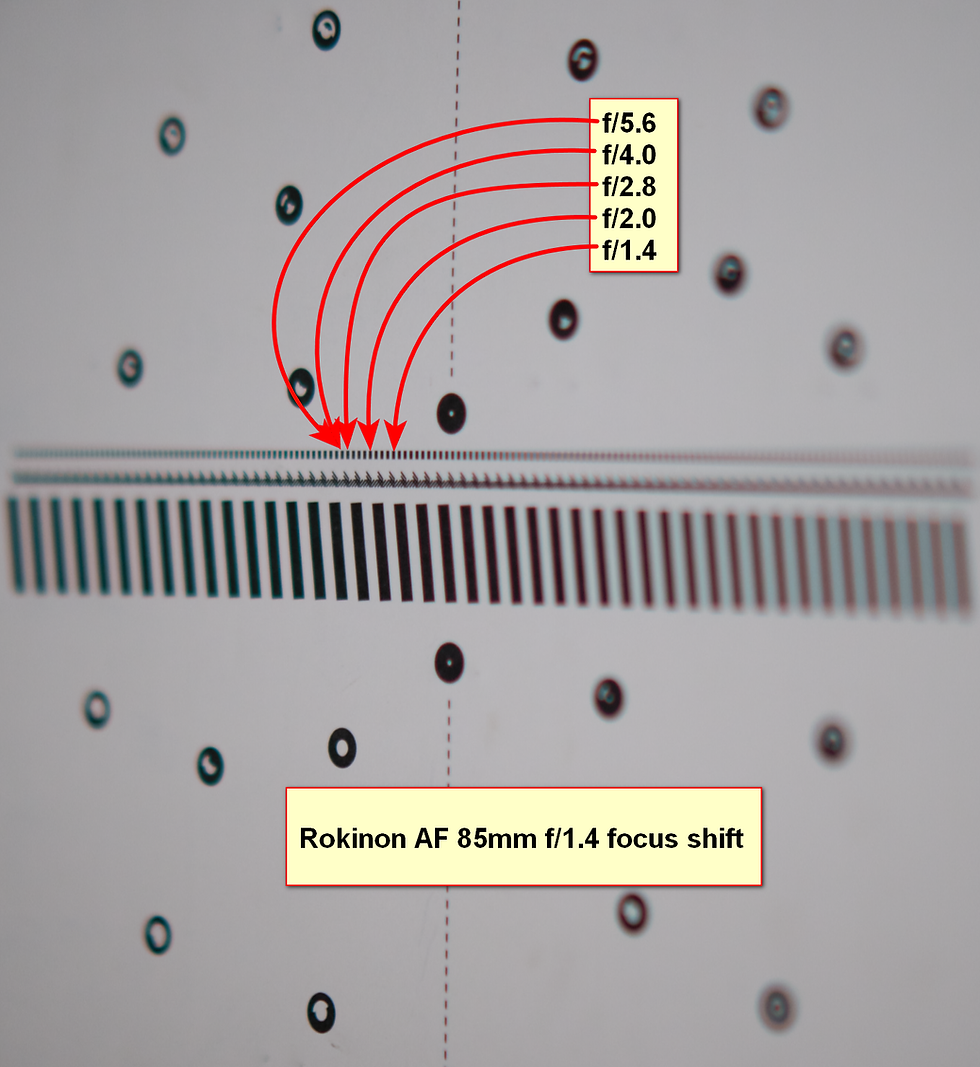
Spherical aberration causes focus shift
I drew arrows showing how the center of focus changes as the lens gets stopped down. The lens was focused at f/1.4, and then subsequent shots were taken while only changing the aperture. Focus keeps moving away from the camera, caused by spherical aberration.
This effect is very common for fast lenses. It shows how you need to focus at the shooting aperture to nail correct focus.

f/5.6 looks sharp and vignetting has disappeared
Summary
This lens was a big disappointment, primarily due to its poor resolution. The edges of the frame are particularly bad until f/8.
It’s always possible that I got the proverbial ‘bad copy’. I’m definitely not going to get another one just to see if that’s true. Needless to say, I got rid of this lens; I felt too guilty to actually sell it, so gave it away.


Social online (fiwfans-asia) websites have become an important part of modern communication. They allow people to create profiles, share photos, post updates, exchange messages, and connect with others from different places. Users can follow friends, join communities, discover interesting content, and participate in online discussions. These platforms make communication faster and more convenient, especially for people who live far apart. Social websites can also help businesses promote products and communicate with customers. At the same time, users should protect their personal information, choose strong passwords, and think carefully before sharing content. Responsible use can make social online websites enjoyable, useful, and informative.
Mình thích cách các thông tin được sắp xếp theo trình tự vì điều đó giúp việc đọc không bị rối. Với những người thường xuyên kiểm tra xsmn, một bảng kết quả rõ ràng có thể tiết kiệm thời gian và hỗ trợ việc đối chiếu giữa các ngày khác nhau.
Agario looks simple, but there’s much more strategy than you might expect! 🟢 Starting as a tiny cell means carefully collecting pellets, watching larger players, and choosing the right moment to take a risk. Every bit of growth feels rewarding, especially when you eventually become the player everyone else is trying to avoid!