Brightin Star 50mm f/1.05 Lens Review
I tested this lens on a Nikon Z8 and Z9 camera with the Z mount, but the same optics are available for E, Z, L, and RF camera mounts. This is a full-frame lens with manual focus. This lens is only 0.23 stops slower than the fast f/0.95 lenses, such as the Nikkor 58mm f/0.95 Noct Z-mount and Leica 50mm Noctilux-M f/0.95 lenses. That Leica lens is selling for over $14,000 U.S.!
This all-metal lens weighs just 632 grams, is 70mm diameter, and 84mm long. It’s a little larger than typical 50mm lenses. For comparison, the Nikkor 58mm f/0.95 Noct lens weighs 2000 grams, 153mm long, 102mm diameter, and it’s also manual focus without any built-in anti-vibration. Also note that the Noct costs about 26X more than this lens.
There aren’t any electronics in this lens, so your camera has to be configured with “Non-CPU Lens Data” in the Setup menu. This will allow the camera IBIS system to correctly handle anti-vibration, and to know the lens maximum aperture. Unfortunately, the file EXIF data won’t record the aperture in use. Camera IBIS systems are good enough that in-lens vibration reduction features aren’t really much of a priority anymore.
With really fast lenses like this one at f/1.05, I’d recommend that you shoot in ‘continuous’ mode when hand-holding and the focused subject is near the camera. The focus plane gets razor thin, and missed focus is really common. This way, you can just delete the missed-focus shots after the fact.
For critical focus, it’s highly recommended that you configure your camera to use focus-peaking at “low sensitivity”, which is also the most accurate. I also programmed my camera “fn2” button for “Zoom on/off” at 100%. This way, I can toggle between normal magnification and high magnification for critical focus at the touch of a button. The Z9 and Z8 let you go all the way up to 200% zoom, if desired. Even at 100% zoom, the focus-peaking still works at f/1.05.
The focus ring rotates about 135 degrees, which is a little tough to fine-tune focus when zoomed in at 100%.
There’s no weather sealing, so stay out of the rain. And never, ever photograph those festivals where they throw colored powder at each other.
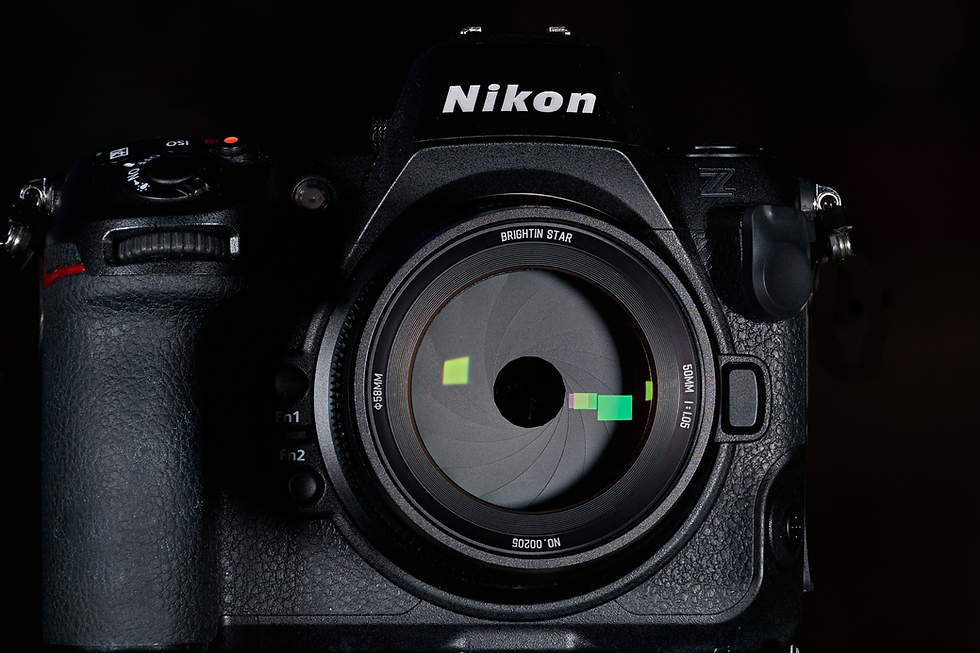
Brightin Star 50mm f/1.05 with 15-blade aperture on Nikon Z8
Who makes lenses with 15 aperture blades? Even the Nikkor 58mm Noct lens only has 11 blades. You’ll need to look at the aperture scale on the top of the lens to set the aperture. The aperture ring is continuous (no clicks) and only stops down as far as f/11.
The lens uses 58mm filters. You don’t get a lens hood included with this lens, but you can buy cheap screw-on hoods. I got a screw-on lens hood that has 82mm threads on its front end that accepts my 82mm filters and 82mm lens caps. I always keep the lens hood on while shooting.

Lens aperture has no-click and range of f/1.05 through f/11.0
The lens focus scale shown above lets you focus down to 0.557 meters, where the lens front is 0.443 meters from the subject (which I measured). Both the focus ring (toward the lens rear) and the aperture ring (near the lens front) are pure metal with a black anodized coating.
It takes a little getting used to the no-click aperture, although most of the time I leave the aperture parked at f/1.05. You need to look at the lens top to set the aperture.

Spherical Aberration
Most high-speed lenses suffer from spherical aberration. This effect causes focus to shift as you change the lens aperture. This Brightin Star has a very slight spherical aberration, and focus shifts away from the camera as you stop down.
Longitudinal Chromatic Aberration (LoCA)

LoCA at f/1.04 (top) versus f/2.8 (bottom)
This lens has moderate LoCA when the lens aperture is wide-open, and it almost disappears by the time you stop down to f/2.8. The bright neutral subject fringes are reddish in front of the focused subject and greenish behind the focused subject.
Lateral Chromatic Aberration

The worst lateral chromatic aberration (CA) this lens exhibits is at f/1.05, where it has about a 5 micron shift. This is minor, but visible. You can correct for this in photo editors.
Lens Elements

Lens elements, via Brightin Star web site
The lens has 10 elements in 8 groups. If that sounds complicated, the Nikkor 58mm f/0.95 Noct Z lens has 17 elements in 10 groups!
Distortion
There’s a very, very slight barrel distortion. I have never bothered to correct for it when editing, because it’s ignorable.
Infrared
This lens can be used for infrared, although it starts showing central flare when stopped down. At wide apertures, it’s just fine. The central light spot starts appearing at f/4 (using 850nm IR) depending upon your subject. At shorter infrared wavelengths, you should see fewer problems. I like shooting with very long IR wavelengths, including 850nm.

850nm infrared at f/1.05

850nm infrared at f/5.6 doesn’t have any central hot spot.
Some subjects start to show a hot spot by f/5.6, but most don’t.
MTF Contrast Plot

Brightin Star claimed MTF versus my measured MTF
The upper plot, from the Brightin Star website, shows their theoretical MTF contrast (at 10,20,30 lp/mm). I measured the MTF contrast at f/1.05 myself, at 10,30, and 50 lp/mm which I show in the lower plot. Reality is a tough mistress.
Cat’s Eye

Out-of-focus lights show typical cat’s eye. f/1.05
I really like the bokeh from this lens. It’s very easy on the eyes.
Field Curvature

Field curvature: none
Photoshop "Find Edges" feature
Flat lawn grass shot at f/1.05 was processed in Photoshop. This is a very effective way to visualize if the plane of focus stays flat or not. This lens shows no noticeable field curvature.
Sharpness versus aperture

f /1.05 edge-to-edge sharpness
The small subjects above were shot at about 1 meter, including the left and right frame edges to observe loss of acuity on the frame edges. This lens did pretty well across the frame. Note how shallow the plane of focus is.

Central sharpness crop at f/1.05, f/1.4, f/2.0 (top-to-bottom)
Just looking up close at the middle bird in these crops.
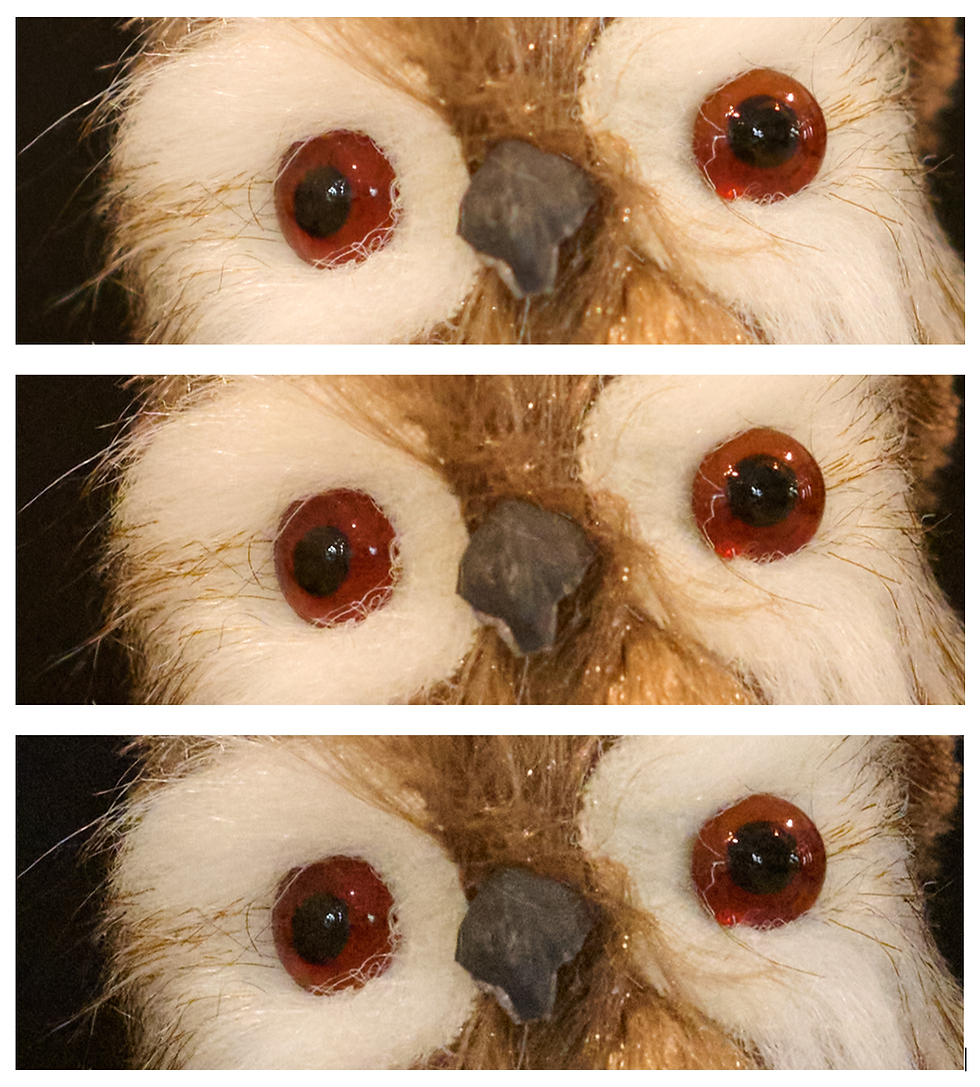
Central sharpness crop at f/2.8, f/4.0, f/5.6 (top-to-bottom)
Even wide-open, this lens is acceptably sharp. It just keeps getting sharper as you stop down. Even the small fibers are resolved at f/1.05. Contrast takes a jump going from f/1.05 to f/1.4.

Brightin Star 50mm f/1.05 1/200s ISO 140

Crop from the shot above
The whiskers of this bunny are sharp, even though I shot it at f/1.05. Super skinny depth of focus.
Bokeh

Brightin Star 50mm f/1.05 1/500s ISO 64
The background melts away quite nicely.
Resolution Tests

f/1.05 MTF50 lp/mm peak values: Mid 35.4, Edge 35.0, Corner 26.1
There is a small amount of barrel distortion, which is easily corrected in an editor if it bothers you. The resolution chart photo shows what the vignetting at f/1.05 looks like. Again, this moderate vignetting can be easily corrected with an editor.
I have always maintained that lenses start looking sharp at about 30 lp/mm, so this lens passes that criteria even at f/1.05. Corners are still slightly blurry, though.

f/1.4 MTF50 lp/mm peak values: Mid 38.0, Edge 39.6, Corner 23.5

f/2.0 MTF50 lp/mm peak values: Mid 41.4, Edge 45.5, Corner 33.1
Starting at f/2.0, the corners are now acceptable.

f/2.8 MTF50 lp/mm peak values: Mid 63.2, Edge 55.9, Corner 54.7

f/4.0 MTF50 lp/mm peak values: Mid 68.8, Edge 67.7, Corner 66.1
This is the sharpest aperture in general, but f/5.6 is about the same.
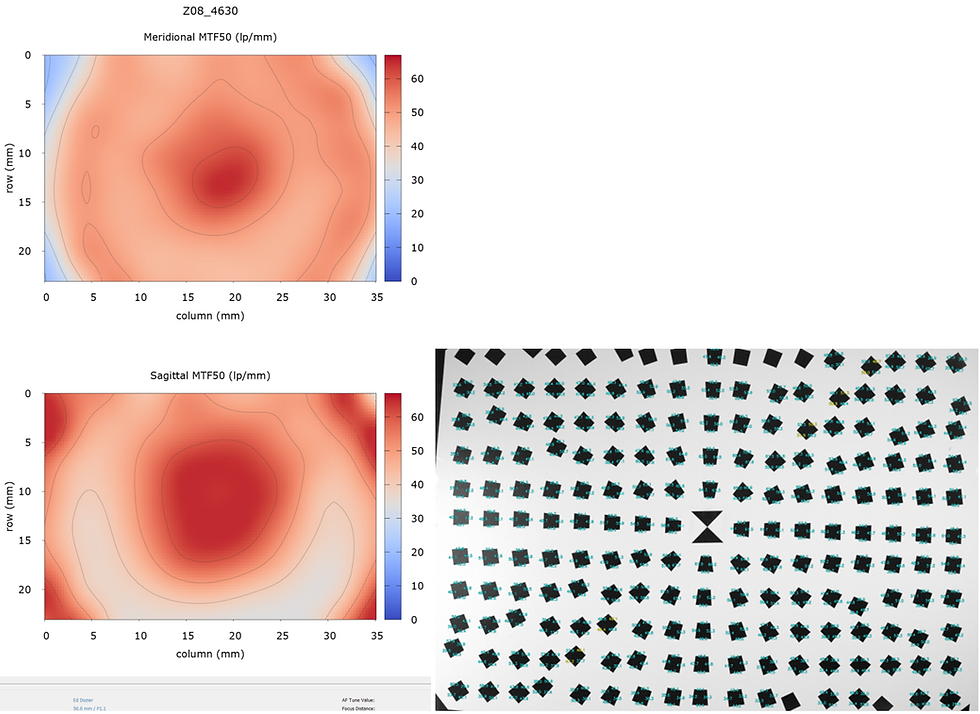
f/5.6 MTF50 lp/mm peak values: Mid 68.2, Edge 68.1, Corner 64.9
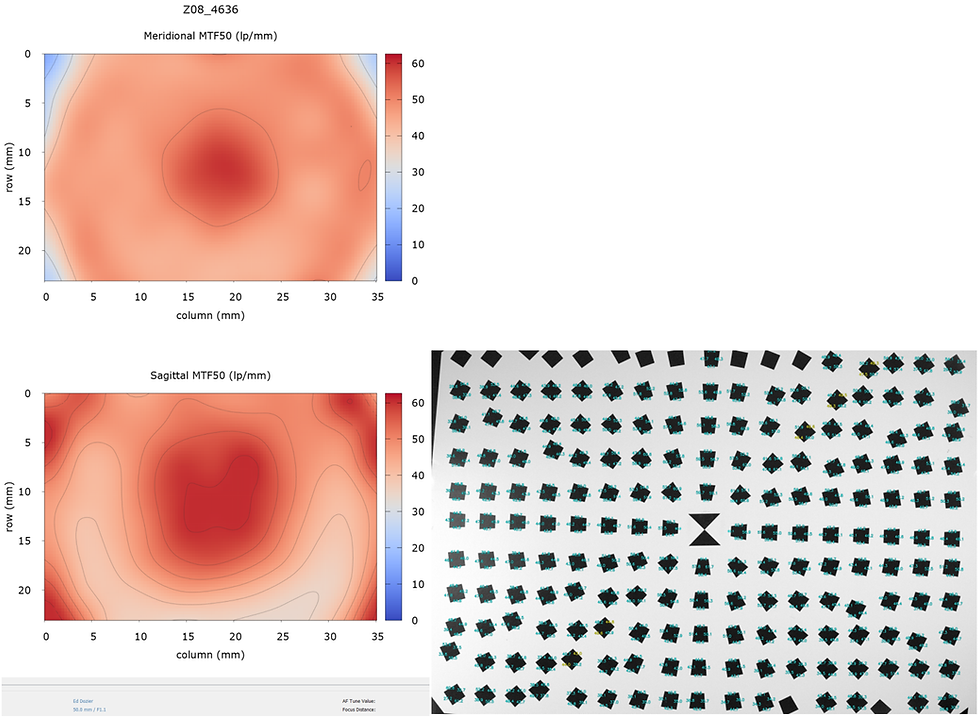
f/8.0 MTF50 lp/mm peak values: Mid 63.1, Edge 61.8, Corner 61.2
Sample shots
50mm f/1.05 1/125s ISO 8000

50mm f/1.05 1/80s ISO 8000
A very rare 1936 Chrysler Imperial Airflow Sedan. These were actually designed with the help of a wind tunnel. Shot in very dim lighting.

50mm f/2.8 1/25s ISO 8000
Those 15 aperture blades make really nice subtle spikes on lights (with 30 spikes). No coma observed; just some bunnies doing lawn maintenance.

50mm f/1.05 0.5s ISO 8000, extremely dim lighting
Summary
I really enjoy shooting with this lens. Manual focus isn’t that much of a hardship when using focus-peaking combined with my camera’s zoom-toggle function button assignment.
It’s liberating to be able to shoot in the dimmest of conditions. The corners of the images aren’t sharp wide-open, but that’s rarely a problem. Given the price of this lens, the optical performance is really remarkable.
I’m not claiming that this lens is on the same level as the $8,000 Nikkor 58mm f/0.95 Noct or the $14,000 Leica 50mm f/0.95 Noctilux-M, but you could probably get this lens along with a used car to drive it around in for the same price.
I have no idea about the manufacturing quality control that Brightin Star has, but this particular lens is a keeper.


Really enjoyed reading "Brightin Star 50mm f/1.05 Lens Review", and a few points were immediately actionable for me. This fits well with Calculate Michigan paycheck deductions and net pay in one. I will revisit this post again.
This detailed review of the Brightin Star 50mm f/1.05 lens offers valuable insights into its optical performance, build quality, and real-world usability for photographers seeking an affordable ultra-fast lens. The analysis effectively balances technical precision with practical shooting experience, highlighting strengths such as sharpness, bokeh quality, and low-light capabilities while honestly discussing limitations like manual focus and lack of weather sealing. The comparison with premium high-end lenses also helps readers understand the lens’s impressive value proposition. Much like Car Protection Film preserves a vehicle’s appearance and long-term value, a high-quality lens helps photographers protect and elevate the visual quality of their creative work.